What Parts of the Body Does a Rowing Machine Work? Revealed
Most gym equipment has a specialty. Treadmills train your legs. Bicep curls build your arms. Even the beloved barbell asks you to choose push or pull, upper or lower. But one machine quietly breaks every rule of single-focus fitness, and millions of people are only just discovering it.
- The Four Phases of the Rowing Stroke: Why Every Muscle Gets Its Turn
- Lower Body: The Powerhouse of Every Stroke
- Core Muscles: The Silent Foundation of Every Row
- Upper Body: Rowing Machine Muscles Trained Above the Waist
- Cardiovascular and Respiratory Systems: Beyond Muscles
- Rowing Machine Muscle Activation: By the Numbers
- Who Benefits Most From Rowing Machine Training?
- Common Mistakes That Reduce Muscle Activation
- Conclusion
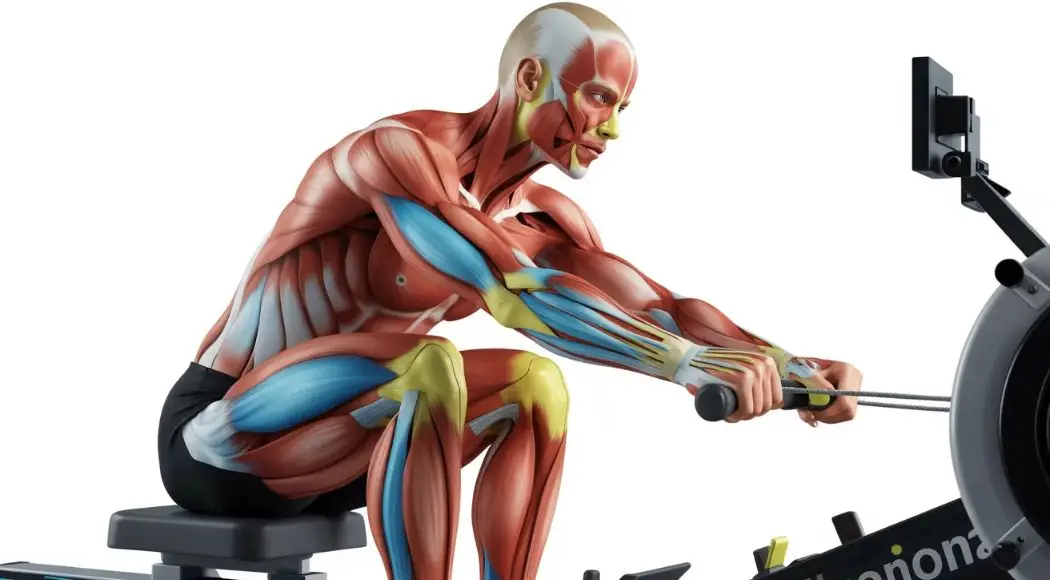
The rowing machine works 86% of the muscles in the human body in a single, fluid, rhythmic motion. No other cardiovascular machine not the elliptical, not the stationary bike, not the stair climber comes close to that number. It trains strength and endurance simultaneously, burns calories at elite rates, and does all of this with remarkably low joint impact, making it accessible to athletes and rehabilitation patients alike.
So exactly what parts of the body does a rowing machine work and how deeply does it engage each one? That is the question this guide answers completely, drawing on sports science research, anatomical evidence, and real-world performance data.
The Four Phases of the Rowing Stroke: Why Every Muscle Gets Its Turn
Before examining individual muscles, it is essential to understand how a rowing machine activates the body. Every stroke follows four distinct mechanical phases, and each phase recruits a different primary muscle group.
Phase 1: The Catch
The starting position. Knees are bent, shins vertical, arms extended forward, core engaged. The legs, ankles, and hip flexors are loaded and ready to drive.
Phase 2: The Drive
The power phase. Legs push down first, then the back opens, then the arms pull. This sequential chain legs → back → arms is the engine of rowing and engages the majority of muscle groups.
Phase 3: The Finish
Arms are pulled to the lower chest, back is slightly reclined, legs are fully extended. The biceps, rear deltoids, rhomboids, and core stabilizers are at peak contraction.
Phase 4: The Recovery
The stroke is reversed in sequence: arms extend first, then the body hinges forward, then the legs bend to return to the catch. This phase actively engages the triceps, hip flexors, and anterior tibialis.
Understanding these phases reveals why what parts of the body does a rowing machine work is never a simple answer it is a coordinated, whole-body sequence.
Lower Body: The Powerhouse of Every Stroke
A common misconception about rowing is that it mainly works the arms and back. However, when examining What Parts of the Body Does a Rowing Machine Work, the lower body plays the biggest role. Rowing is approximately 60–65% a lower body exercise, with the legs generating the majority of propulsive force on every stroke.
Quadriceps (Front Thigh Muscles)
The quadriceps comprising the rectus femoris, vastus lateralis, vastus medialis, and vastus intermedius fire explosively during the drive phase as the knees extend. A 2014 study published in the Journal of Strength and Conditioning Research confirmed that quadricep activation during ergometer rowing is comparable to that achieved during leg press exercises at moderate resistance.
Hamstrings (Rear Thigh Muscles)
The hamstrings work in two distinct ways: eccentrically controlling knee extension during the drive, and concentrically during hip extension as the body opens up. Strong hamstrings are critical for injury-free, powerful rowing.
Gluteus Maximus (Buttocks)
The glutes are the largest and most powerful muscles in the human body, and rowing demands their full engagement. As the hips extend from the compressed catch position to the open finish, the gluteus maximus is the primary driver making rowing one of the most effective glute-strengthening exercises available on any cardio machine.
Calves (Gastrocnemius and Soleus)
Often overlooked in rowing discussions, the calves stabilize the ankle and assist with foot-drive mechanics throughout every stroke cycle.
Core Muscles: The Silent Foundation of Every Row
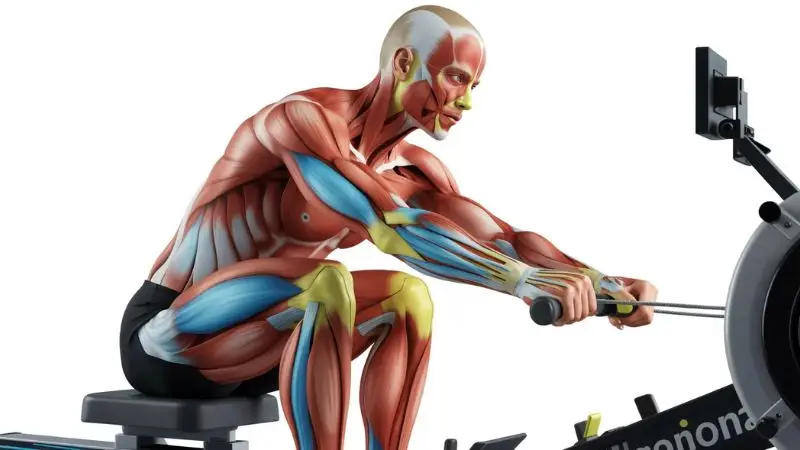
When people ask what parts of the body does a rowing machine work, the core answer is often underestimated. Rowing demands constant core engagement not as an accessory, but as structural necessity.
Rectus Abdominis
The “six-pack” muscle stabilizes the spine during the powerful hip hinge of the drive phase and controls forward lean during recovery.
Transverse Abdominis
The deepest abdominal muscle acts as an internal weight belt, protecting the lumbar spine from compressive forces generated during maximum-effort rowing.
Obliques (Internal and External)
Rotational stability is key to efficient rowing technique. The obliques prevent unwanted lateral trunk movement and maintain stroke efficiency over longer sessions.
Erector Spinae (Lower Back)
The erector spinae muscles run along either side of the spine and are heavily recruited during the back-opening sequence of the drive phase. This is one reason why understanding What Parts of the Body Does a Rowing Machine Work is important. Research from the British Rowing federation confirms that rowers develop significantly greater lower back endurance compared to non-rowing athletes an adaptation directly caused by repetitive erector spinae loading.
Upper Body: Rowing Machine Muscles Trained Above the Waist
When people ask, “What Parts of the Body Does a Rowing Machine Work?”, many assume the exercise is primarily focused on the back and arms. In reality, the upper body accounts for approximately 25–30% of rowing power, but its contribution to muscular development is disproportionately high due to the intensity of the pulling motion.
Latissimus Dorsi (Lats)
The lats the broad, wing-shaped muscles of the mid-back are the primary upper-body movers in rowing. They drive the arms downward and backward during the pull, producing the characteristic V-shaped back development seen in competitive rowers.
Rhomboids and Middle Trapezius
These muscles between the shoulder blades retract the scapulae at the finish of each stroke. Regular rowing strengthens the rhomboids significantly, which is valuable for correcting the postural rounding associated with desk-based work.
Rear Deltoids (Posterior Shoulders)
The rear deltoids assist the lats in the final pull and are chronically underdeveloped in people who focus primarily on pressing exercises. Rowing naturally corrects this imbalance.
Biceps Brachii
The biceps flex the elbow during the arm-pull phase. While not the primary mover, they experience substantial volume over a typical rowing session a 20-minute moderate session involves approximately 240–300 arm-pull repetitions.
Triceps Brachii
During the recovery phase, as arms extend forward to return to the catch, the triceps work concentrically against resistance giving them meaningful stimulus despite rowing being a pulling exercise.
Cardiovascular and Respiratory Systems: Beyond Muscles
What parts of the body does a rowing machine work extends beyond skeletal muscle into the body’s internal systems and this is where rowing’s true superiority as a training tool becomes clear.
Cardiovascular System
When exploring What Parts of the Body Does a Rowing Machine Work, it’s important to remember that rowing benefits far more than just your muscles. Rowing at moderate intensity elevates heart rate to 65–85% of maximum for most individuals, firmly within the aerobic training zone. A Harvard Health study found that a 185-pound person burns approximately 440 calories per hour rowing at moderate effort, comparable to running at 5 mph but with dramatically lower joint stress.
Respiratory System
The rhythmic breathing pattern demanded by rowing exhaling on the drive, inhaling on the recovery trains respiratory muscle endurance over time. Elite rowers demonstrate lung capacity (VO2 max) values among the highest recorded in any sport.
Bones and Connective Tissue
Rowing is a weight-bearing exercise (unlike swimming or cycling), meaning it applies beneficial stress to bones, tendons, and ligaments contributing to long-term skeletal health and reduced osteoporosis risk.
Rowing Machine Muscle Activation: By the Numbers
| Body Region | Muscles Engaged | % of Total Power Output |
| Legs | Quads, hamstrings, glutes, calves | 60–65% |
| Core | Rectus abdominis, erector spinae, obliques | 10–15% |
| Back | Lats, rhomboids, trapezius | 15–20% |
| Arms & Shoulders | Biceps, triceps, rear deltoids | 10–15% |
Who Benefits Most From Rowing Machine Training?
Understanding what parts of the body does a rowing machine work also means recognizing which populations gain the most:
- Beginners: Full-body stimulus from a single machine reduces programming complexity
- Weight loss seekers: High caloric burn with low injury risk
- Older adults: Joint-friendly cardio that also preserves muscle mass
- Rehabilitation patients: Widely prescribed for knee and hip recovery due to its non-impact nature
- Athletes: Cross-training tool that develops posterior chain strength transferable to most sports
- Office workers: Directly counteracts the effects of prolonged sitting by strengthening posterior chain muscles
Common Mistakes That Reduce Muscle Activation
Even knowing what parts of the body does a rowing machine work is not enough if technique is poor. These errors significantly reduce effectiveness:
- Leading with the back instead of the legs reduces power output and risks lumbar strain
- Hunching the shoulders disengages the lats and rhomboids
- Pulling too high (above the lower chest) shifts load away from lats onto smaller shoulder muscles
- Rushing the recovery eliminates the eccentric stimulus that builds strength
- Incorrect damper setting a setting of 3–5 is optimal for most users; higher is not always better
Conclusion
When you step back and examine the full picture of what parts of the body does a rowing machine work, the answer is almost every part. From the gluteus maximus generating explosive leg drive to the rhomboids retracting at the finish, from the transverse abdominis bracing the spine to the cardiovascular system surging through each stroke rowing is the most complete single-machine workout available to the general fitness population.
It builds strength. It trains endurance. It burns calories efficiently. It protects joints. And it corrects postural imbalances that virtually every modern adult carries.