Chain Thickness Guide: How to Choose the Perfect Size for Every Use
Whether you’re shopping for a sleek thick silver chain to complement your outfit, replacing a bicycle drivetrain, or sourcing industrial rigging equipment one spec quietly determines everything chain thickness.
It affects how strong a chain is, how it looks, how long it lasts, and whether it’s right for the job at all. Yet most buyers overlook it entirely, relying on guesswork instead of data.
This guide changes that. Drawing on manufacturer specifications, engineering standards, and real-world testing data, we’ll walk you through everything you need to know from what chain thickness actually measures, to exactly which gauge works best for jewelry, cycling, and heavy-load applications.
What Is Chain Thickness? (And Why Does It Matter?)
Chain thickness refers to the diameter or gauge of the wire or bar stock used to form each individual chain link. It is typically measured in millimeters (mm) or inches and is one of three critical dimensions alongside link length and link width that define a chain’s overall profile.
Here’s why it matters across every category:
- Strength: Thicker chains have greater tensile strength and load-bearing capacity
- Weight: A thicker chain is noticeably heavier — important for both wearability and shipping costs
- Flexibility: Thinner chains drape more fluidly; thicker ones are more rigid
- Durability: Greater thickness means more material to resist abrasion, corrosion, and fatigue
- Aesthetics: In jewelry, chain thickness is the single biggest visual differentiator between delicate and bold styles
Chain Thickness by Category
1. Jewelry Chains: Finding Your Ideal Gauge
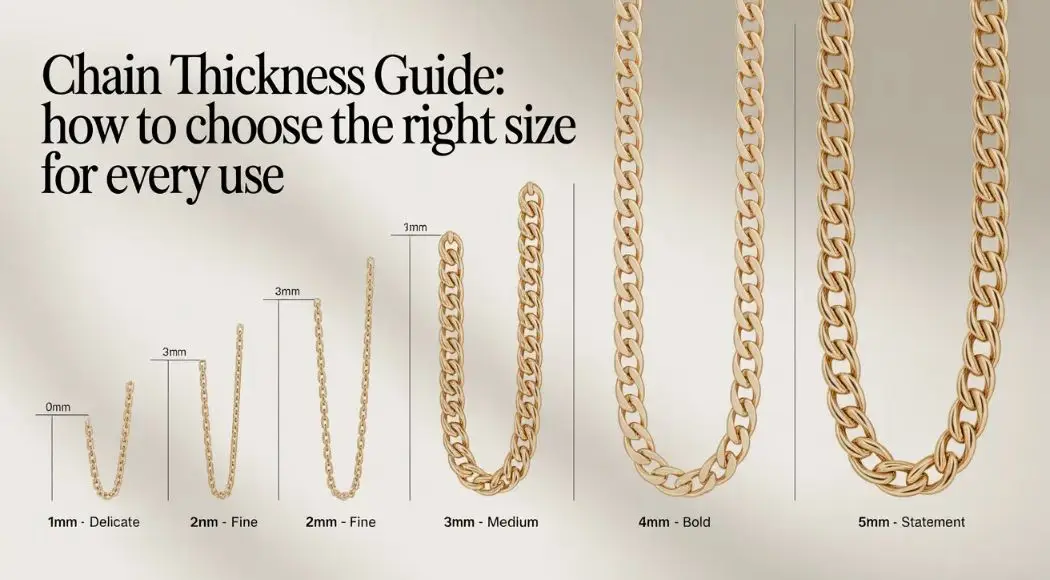
In the jewelry world, chain thickness is measured in millimeters and directly determines whether a piece reads as dainty or statement-making.
Common jewelry chain thickness ranges:
| Thickness | Style Profile | Best For |
| 0.5 – 1.0 mm | Ultra-delicate | Lightweight pendants, layering |
| 1.0 – 1.5 mm | Delicate | Everyday wear, small charms |
| 1.5 – 2.5 mm | Medium | Versatile daily chains |
| 2.5 – 4.0 mm | Bold | Statement pieces, men’s jewelry |
| 4.0 mm+ | Chunky/Heavy | Fashion-forward, streetwear |
A thick silver chain in the 3–5mm range has become one of the most searched jewelry items over the past three years, driven by streetwear culture and celebrity styling. According to data from major retailers like Mejuri and Tiffany & Co., chunky chain necklaces in the 4–6mm range consistently rank among their top-selling men’s and unisex pieces.
Real-world example: A 4mm Cuban link chain in sterling silver is considered the benchmark for a bold everyday chain thick enough to be noticed, but not so heavy that it becomes uncomfortable after a few hours.
Pro tip: When buying a chain for a pendant, match the chain thickness to the bail size of your pendant. A 3mm chain through a 2mm bail creates an awkward fit and accelerates wear.
2. Bicycle Chains: Precision Thickness for Performance
Bicycle chain thickness is measured differently primarily by the inner width and outer width of the chain, as well as the plate thickness. For road and mountain bikes, the outer width has narrowed over decades as drivetrains moved from 5-speed to 12-speed systems.
The trend is clear: as gears multiply, chains get thinner and more precise. A 12-speed chain is nearly 33% narrower than a 6-speed chain, which demands more careful maintenance and lubrication.
Why it matters for cyclists: Using a chain with incorrect thickness for your drivetrain causes ghost shifting, accelerated wear on cassette teeth, and potential chain snap under load a dangerous scenario on a fast descent.
3. Industrial & Load-Bearing Chains: Thickness = Safety
For lifting, rigging, towing, and anchoring, chain thickness is not a style preference it is a safety-critical specification governed by international standards including ASME B30.9 and EN 818.
Industrial chains are graded (e.g., Grade 30, Grade 43, Grade 70, Grade 80, Grade 100), and within each grade, the chain diameter directly determines the Working Load Limit (WLL).
Example: Grade 80 Alloy Chain WLL by Diameter
| Chain Diameter | Working Load Limit |
| 6 mm | 1,120 kg |
| 8 mm | 2,000 kg |
| 10 mm | 3,150 kg |
| 13 mm | 5,300 kg |
| 16 mm | 8,000 kg |
Source: Industry-standard load tables per EN 818-2
Critical rule: Never exceed the rated WLL for a given chain diameter, and always apply a safety factor (typically 4:1) in lifting applications. Choosing a chain that is too thin for the load is a leading cause of industrial accidents.
How to Measure Chain Thickness Accurately
Whether you’re replacing a lost necklace or auditing warehouse equipment, measuring chain thickness correctly takes less than two minutes with the right tool.
What you need: A digital vernier caliper (accurate to 0.01mm)
Steps:
- Place the chain on a flat surface
- Open the caliper jaws and position them around a single link’s wire cross-section
- Close gently until snug do not compress the metal
- Read the measurement in millimeters
- Take three readings from different links and average them for accuracy
Common mistakes to avoid:
- Measuring across the full link (you’ll get link width, not wire thickness)
- Using a ruler instead of a caliper (margin of error is too large)
- Measuring a worn section of chain (abrasion can reduce apparent thickness by 0.2–0.5mm)
Chain Thickness and Material: A Critical Combination
Thickness alone doesn’t tell the whole story. A 3mm stainless steel chain and a 3mm gold-plated brass chain are worlds apart in durability.
For a thick silver chain designed for daily wear, 925 sterling silver at 3mm or above gives a good balance of visual impact and durability though it will tarnish over time without proper care.
Choosing the Right Chain Thickness: A Quick Decision Guide
For jewelry:
- Layering look → 1.0–1.5mm
- Everyday pendant chain → 1.5–2.5mm
- Bold statement piece → 3.0mm+
- Men’s Cuban or rope chain → 4.0–6.0mm
For cycling:
- Vintage/single-speed → 1/8″ inner width chains
- Modern road/MTB → Match exactly to your drivetrain speed
For industrial use:
- Always consult load tables and apply a 4:1 safety factor
- When in doubt, size up not down
Conclusion
Chain thickness is one of the most practical specifications you’ll encounter whether you’re building an outfit, tuning a drivetrain, or rigging a load. Getting it right means better performance, longer lifespan, and in the case of industrial chains, genuine safety.
The key takeaways:
- Jewelry chains range from 0.5mm to 6mm+ match thickness to your style intent and pendant size
- A bold thick silver chain typically starts at 3mm; statement streetwear pieces go 4mm and above
- Bicycle chains have become progressively thinner as gear counts rise always match to your speed
- Industrial chain thickness is a regulated safety specification never guess
Before your next purchase, take two minutes to measure or verify the chain thickness. It’s the one number that affects everything else.