Never Buy the Wrong Table Runner Size Chart Again
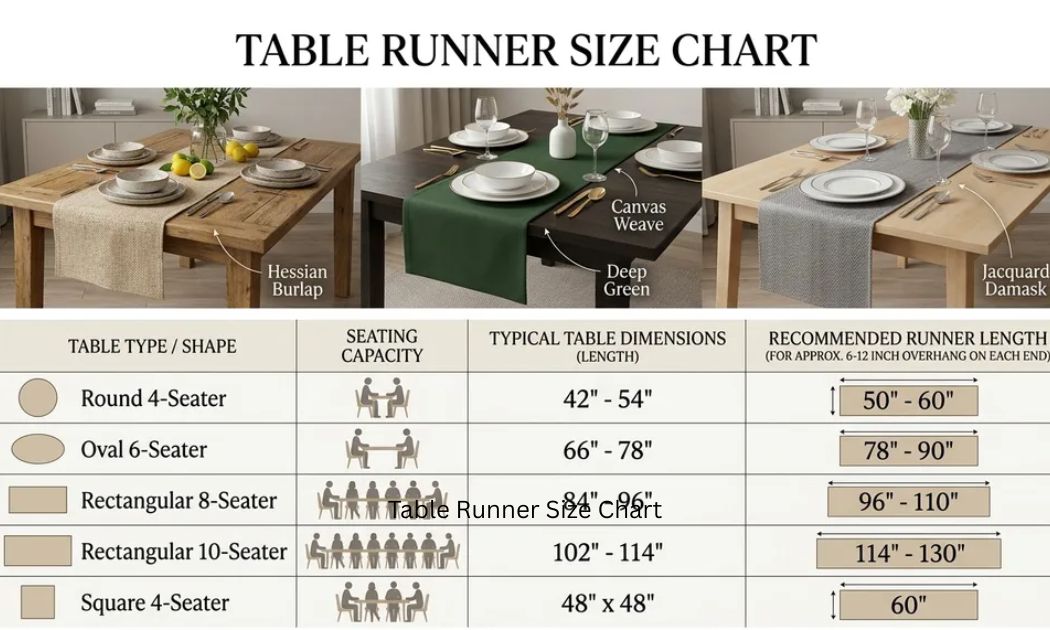
Choosing the right table runner starts with understanding the table runner size chart because even the most beautiful runner can ruin a tablescape if it’s the wrong size. Whether you’re decorating for a wedding, holiday dinner, or everyday styling, getting the dimensions right is everything.
- What Is a Table Runner and Why Does Size Matter?
- How to Measure Your Table for a Runner
- Complete Table Runner Size Chart
- Runner Sizes by Table Type
- Standard Runner Widths Explained
- Choosing Runner Size by Occasion
- Common Mistakes to Avoid
- Expert Advice: What Interior Designers Recommend
- Conclusion
- Frequently Asked Questions (FAQ)
In this guide, you will find a complete table runner size chart, expert tips on measuring your table correctly, and practical advice for every table type and occasion. By the end, you will know exactly which size works best for your setup—no guesswork needed.
What Is a Table Runner and Why Does Size Matter?
A table runner is a long, narrow piece of fabric placed along the center of a dining table, console table, or buffet. It adds color, texture, and elegance while also protecting the table surface.
Size matters because:
- A runner that is too short looks awkward and unbalanced
- A runner that is too long creates a tripping hazard or looks sloppy
- The right-sized frames your table beautifully and ties the whole look together
Interior designers and home décor experts consistently agree that the standard overhang on each end should be between 6 to 12 inches for a polished, professional look.
How to Measure Your Table for a Runner
Before using any size chart, you need to measure your table accurately. Here is how:
- Measure the length of your table from end to end
- Decide your overhang; most designers recommend 6 to 12 inches per side
- Add the overhang to both ends of the table’s length
- Choose your width; standard runners are 12 to 16 inches wide
Formula:
Runner Length = Table Length + (Overhang x 2)
Example: If your dining table is 72 inches long and you want a 6-inch drop on each side:
72 + (6 x 2) = 84 inches runner length
Complete Table Runner Size Chart
The following table runner size chart covers the most common table sizes and their ideal runner dimensions:
| Table Type | Table Length | Recommended Runner Length | Runner Width |
| Small Dining Table | 48 inches | 60–72 inches | 12–14 inches |
| Standard Dining Table | 60 inches | 72–84 inches | 13–15 inches |
| Large Dining Table | 72 inches | 84–96 inches | 14–16 inches |
| Extra Large Dining Table | 84–96 inches | 96–120 inches | 14–18 inches |
| Console / Sofa Table | 48–60 inches | 60–72 inches | 12–14 inches |
| Coffee Table | 36–48 inches | 48–60 inches | 10–12 inches |
| Round Table (4-seater) | 42–48 inch diameter | 60–72 inches | 12–14 inches |
| Round Table (6-seater) | 54–60 inch diameter | 72–84 inches | 13–15 inches |
| Buffet / Sideboard | 48–72 inches | 60–84 inches | 12–16 inches |
| Banquet / Farmhouse Table | 96–120 inches | 108–132 inches | 15–18 inches |
Pro Tip: Always round up rather than down when in between sizes. A slightly longer runner always looks more intentional and elegant than one that falls short.
Runner Sizes by Table Type
Dining Table Runners
The dining table is the most common place for a runner. For a 6-person dining table (typically 72 inches long), an 84 to 96-inch runner with a 12-inch drop on each side creates the most balanced look.
For formal dining, choose a longer drop of 10 to 12 inches. For casual everyday use, a 6 to 8-inch drop is perfectly fine.
Console and Sofa Table Runners
Console tables typically sit against a wall, so the visual impact is from the front only. A runner that matches the table length with minimal overhang (4 to 6 inches) works best here.
Recommended size: 60 to 72 inches long, 12 to 14 inches wide
Coffee Table Runners
Coffee table runners are shorter and narrower. They should cover roughly two-thirds of the table length and leave equal space on the sides.
Recommended size: 48 to 60 inches long, 10 to 12 inches wide
Round Table Runners
Round tables are unique; runners are placed across the diameter. For a 48-inch round table, a 72-inch runner with equal drops on both sides creates a stunning centerpiece effect.
Many decorators use two runners crossed at the center of a round table for a layered, luxurious look.
Standard Runner Widths Explained
Width is just as important as length. Here is a breakdown:
- 10–12 inches: Ideal for coffee tables and narrow console tables
- 12–14 inches: The most universal width works for most dining tables
- 14–16 inches: Great for wider dining tables and farmhouse-style settings
- 16–18 inches: Best for extra-large or banquet tables where bold visual impact is needed
The standard and most popular runner width sold in stores is 13 inches, which fits most dining tables beautifully.
Choosing Runner Size by Occasion
Different events call for different styling approaches:
Everyday Home Use: Keep it simple. A runner that is 6 inches shorter than your table length on each side with a neutral color works perfectly for daily use.
Formal dinners & holiday tables go longer. A 10 to 12-inch drop on each end adds drama and elegance. Pair with matching placemats and candle holders for a complete look.
Weddings & Events For banquet and farmhouse tables at weddings, runners are often used in multiples placed side by side, or extra-long runners are draped to the floor for a dramatic effect. Floor-length runners should equal table length plus twice the table height.
Formula for floor-length runner:
Runner Length = Table Length + (Table Height x 2)
Common Mistakes to Avoid
Many people make these sizing mistakes when buying runners:
- Measuring only the tabletop without accounting for overhang
- Choosing too narrow a width, which makes the runner look lost on a large table
- Ignoring fabric shrinkage always add 10% extra length if the runner will be washed
- Matching runner length exactly to table length—this looks flat and uninspired
Expert Advice: What Interior Designers Recommend
According to professional interior stylists, the golden rule is the “rule of thirds.” Your runner should cover approximately one-third of the table width, leaving equal space on both sides. This creates visual balance and allows table settings to breathe.
For a 60-inch wide dining table, a 13 to 15-inch wide runner placed at the center leaves roughly 22 to 23 inches of exposed table on each side, perfectly balanced.
This principle is widely used by professional table stylists and event decorators worldwide.
Conclusion
Getting your runner size right is not complicated once you have the right information. Use the table runner size chart in this guide as your go-to reference every time you shop for a new runner. Remember the key rules:
- Always add 6 to 12 inches of overhang on each end
- The width should be one-third of your table’s width
- Round up when in between sizes
- Adjust for occasion: casual needs less drop; formal needs more
A well-sized runner instantly elevates any table from ordinary to beautiful. Bookmark this guide and share it with anyone decorating their home or planning an event.
For more home décor tips, size guides, and styling inspiration, visit us at: OfferedMagazine.
Your trusted source for lifestyle and home décor content.
Frequently Asked Questions (FAQ)
What is the standard table runner size?
The most common standard size is 13 x 72 inches, which fits a typical 6-person dining table with a comfortable overhang on each end.
How much should a table runner hang over the edge?
The recommended overhang is 6 to 12 inches on each side. For formal settings, 10 to 12 inches is preferred. For casual use, 6 to 8 inches works well.
Can I use a runner on a round table?
Yes. Place the runner across the diameter of the round table with equal drops on both sides. Two runners crossed at the center create an even more elegant look.
Should a table runner be the same length as the table?
No. A runner that matches the table length exactly looks flat. Always add at least 6 inches of overhang on each side for a finished, polished appearance.
What width runner is best for a 36-inch wide dining table?
For a 36-inch wide table, a 12 to 13-inch wide runner is ideal; it covers the center third without overwhelming the table surface.