
What Is Carrier Pre Select? Save Money Without Changes
Every business and household that pays a phone bill has, at some point, wondered whether they are on the best possible deal. The answer is often no and for decades, the telecom industry has had a solution that most people never hear about. That solution is carrier pre select, also known as CPS.
- What Is Carrier Pre Select? A Complete Definition
- History and Background: How Carrier Pre Select Came to Exist
- How Carrier Pre Select Works: The Technical Process
- Benefits of Carrier Pre Select
- Limitations and Drawbacks
- Carrier Pre Select vs. VoIP vs. SIP Trunking: Comparison Table
- Global Regulation: How Different Countries Handle CPS
- Real-World Examples and Proof
- Is Carrier Pre Select Still Relevant in 2026?
- How to Set Up Carrier Pre Select: A Practical Guide
- Conclusion:
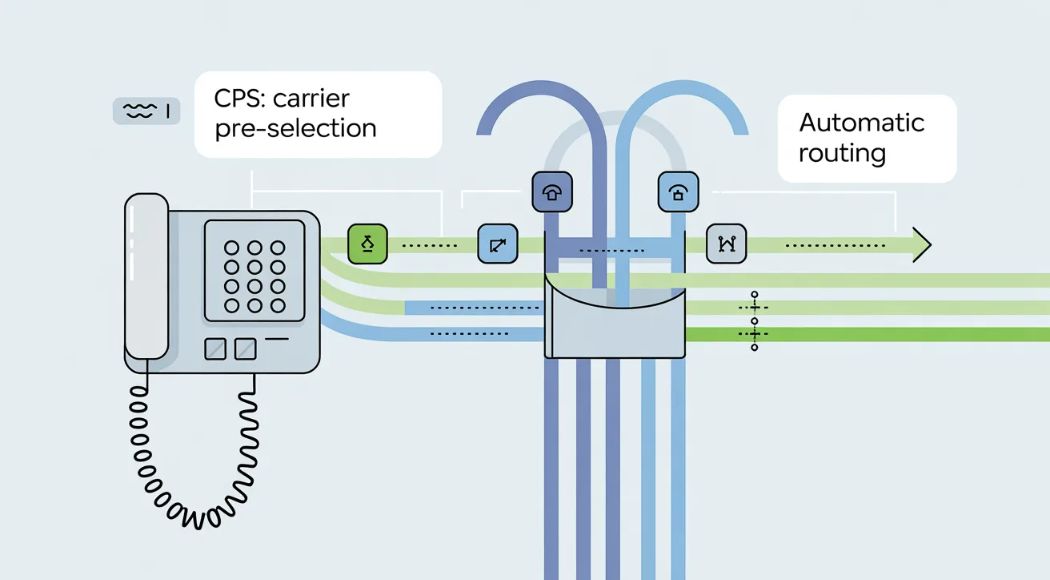
What is carrier pre select? In the simplest terms, it is a telecommunications feature that allows you to automatically route your outgoing phone calls through a different provider’s network, without changing your phone number, without installing new equipment, and without dialing any special codes before each call. Your phone line stays exactly as it is. The only thing that changes is who carries your calls and how much you pay for them.
Understanding what is carrier pre select is increasingly relevant in 2026, even as VoIP and cloud telephony expand. Many businesses and homes still operate on fixed landline infrastructure, and for these users, CPS remains one of the most cost-effective and frictionless tools available for reducing call charges.
This article covers everything what carrier pre select is, how it works at a technical level, its history, benefits, limitations, global regulation, real-world examples, and how it compares to modern alternatives like VoIP and SIP trunking.
What Is Carrier Pre Select? A Complete Definition
Carrier pre select is a telecommunications method that allows a telephone subscriber whose line is maintained by one company usually a former monopoly provider such as BT in the UK to have some or all of their calls automatically routed across a different telephone company’s network without needing to enter a special code or special equipment.
The abbreviation CPS stands for Carrier Pre-Selection. The word “pre” is important: it means the alternative carrier is chosen in advance, at the point of service setup, rather than selected manually before each call. Once CPS is active on a line, the routing happens automatically and invisibly at the local telephone exchange.
Unlike traditional methods that require dialing a prefix such as 1280 or 123, CPS automatically directs calls through the chosen carrier at pre-negotiated rates. The existing line remains active, no manual prefix dialing is required, the service is cost-effective, and users can switch carriers without altering their primary line.
This combination of simplicity and savings is precisely why the question “what is carrier pre select?” has remained a consistent search query globally, even in an era of cloud communications.
History and Background: How Carrier Pre Select Came to Exist
The Problem It Was Designed to Solve
Before CPS existed, telephone customers in most countries were locked to a single provider typically the national incumbent operator that owned the physical infrastructure. In the UK, this was British Telecommunications (BT). In Germany, it was Deutsche Telekom. In the United States, it was the regional Bell Operating Companies. These incumbents set call prices with little competitive pressure, and customers had no practical way to shop around without physically changing their phone lines.
Telecom Deregulation and the Birth of CPS
Carrier pre select is a regulator-imposed system that compels telecoms networks to allow customers to route all their calls through another a competitor’s network. The importance of carrier pre select is that it allows competitors to use an incumbent’s infrastructure. What is Carrier Pre Select is a commonly searched keyword related to this concept.
In the UK, CPS became highly popular after telecom deregulation. It allowed customers to choose alternative providers while keeping BT lines. Germany widely implemented preselection services, especially for long-distance and international calling. Several EU countries supported CPS as part of telecom competition policies. The US used similar systems involving interexchange carriers and long-distance provider selection.
The regulatory framework in the UK is overseen by Ofcom. Carrier Pre-Selection (CPS) is a mechanism that allows consumers who have a BT line to select, in advance, alternative communications providers to carry some or all of their telephone calls without having to dial a prefix.
This regulatory mandate transformed CPS from a niche technical feature into a mainstream consumer and business tool, particularly through the 1990s and 2000s.
How Carrier Pre Select Works: The Technical Process
Understanding what is carrier pre select also means understanding the technical steps that make it function.
Step 1: Customer Agreement
A customer signs up with a CPS provider a telecom company authorized to offer call routing services. The customer specifies which types of calls they want routed: local, national, international, mobile, or all calls.
Step 2: Exchange-Level Configuration
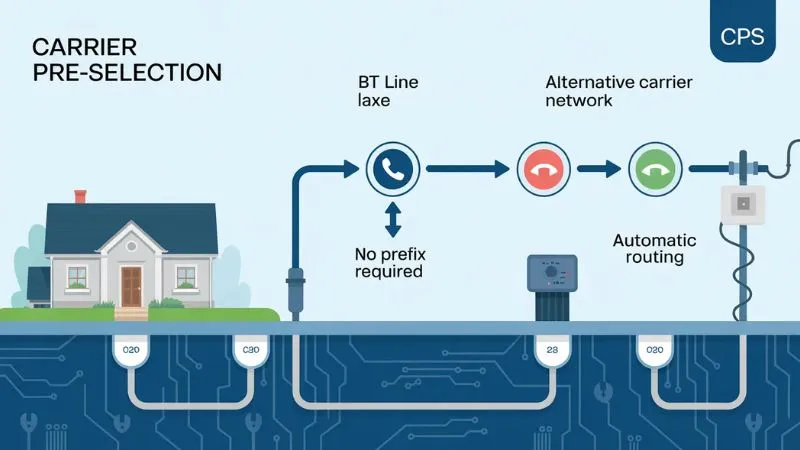
CPS automatically diverts calls from BT to your chosen secondary supplier. There is no installation or programming of equipment required and you don’t have to dial a code to activate the service. When you sign up to a secondary supplier and use the method of Carrier Pre-Selection, your local telephone exchange will automatically re-route all your calls to the secondary supplier’s network. What is Carrier Pre Select is a key concept used to describe this process.
Step 3: Transparent Call Routing
The user does not need to dial a carrier access code before every call. Once the service is active, call routing happens automatically in the background. The process is invisible to the caller. The user dials normally, and the system routes the call through the provider.
Step 4: Separate Billing
The line rental continues to be billed by the original provider (e.g., BT). Call charges for the routed calls are billed separately by the CPS provider. This means the customer typically receives two bills one for the line, one for calls.
Call Types Covered
CPS can be configured to cover different call categories:
- Local calls
- National calls
- International calls
- Calls to mobile numbers
- Premium rate and special tariff calls
Certain types of call are not carried via CPS, regardless of the call option selected, as they are BT services and included in the rental charges. These limitations are important when understanding What is Carrier Pre Select and how the service operates in practice.
Benefits of Carrier Pre Select
Significant Cost Reduction
The primary driver for CPS adoption is cost. One of the biggest advantages of CPS is reduced call charges. Businesses that make frequent long-distance or international calls can save substantially by routing calls through a cheaper provider.
No Equipment or Number Changes
Since CPS operates through the telecom exchange, there is no need for new phones, adapters, or complex installations. Users can keep their existing phone numbers while still benefiting from competitive call rates.
Flexible and Easy to Switch
If a better deal becomes available, users can easily switch CPS providers without disrupting their primary phone service.
Suitable for Businesses and Homes
Any user on a fixed telephone line residential or commercial can benefit from CPS. For businesses with high call volumes such as call centres, customer service teams, and professional services firms, the savings per year can be substantial.
Limitations and Drawbacks
Fully understanding what is carrier pre select means acknowledging its constraints:
- Limited to voice calls: Traditional CPS focuses on voice traffic, not data or broadband services
- Tied to fixed landlines: CPS is not applicable to mobile networks or VoIP-only setups
- Dual billing complexity: Receiving separate bills for line rental and calls can create administrative overhead
- Declining PSTN infrastructure: As governments globally phase out the Public Switched Telephone Network in favour of full-fibre and VoIP, CPS availability will gradually narrow
- Not universally available: CPS regulations differ by country, and not all markets mandate its provision
As more businesses transition to cloud-based phone systems, the long-term demand for CPS may decline.
Carrier Pre Select vs. VoIP vs. SIP Trunking: Comparison Table
| Feature | Carrier Pre Select (CPS) | VoIP | SIP Trunking |
| Infrastructure required | Existing landline (PSTN) | Broadband internet connection | Internet + PBX or hosted system |
| Equipment change needed | None | IP phones or softphones | SIP-compatible PBX |
| Number change required | No | No (porting available) | No (porting available) |
| Call routing | Automatic at exchange | Internet protocol routing | Internet protocol routing |
| Suitable for mobile | No | Yes | Yes |
| International call savings | High | Very high | Very high |
| Setup complexity | Very low | Low to medium | Medium to high |
| Best for | Landline users seeking lower call costs | Businesses wanting full digital telephony | Businesses with existing PBX systems |
| Ongoing relevance (2026) | Declining but still valid | Growing rapidly | Established and growing |
| Regulatory oversight | Yes (Ofcom, EU directives) | Varies by country | Varies by country |
Many businesses today compare carrier pre select with Voice over Internet Protocol (VoIP). VoIP is generally more advanced, but CPS can still be useful where stable landline infrastructure already exists.
Global Regulation: How Different Countries Handle CPS
United Kingdom
The UK’s communications regulator Ofcom mandates that BT must provide CPS access to licensed alternative providers. Carrier Pre-Selection is a mechanism that allows consumers who have a BT line to select, in advance, alternative communications providers to carry some or all of their telephone calls without having to dial a prefix. Providers must pay BT a set-up charge for each line activated for CPS. This is a core explanation of What is Carrier Pre Select.
European Union
CPS implementation across the EU was driven by the 1997 European Commission directive on telecommunications competition, which required all member states to unbundle local loops and allow alternative carrier access. Germany, France, the Netherlands, and other major European markets implemented CPS frameworks that drove significant consumer savings through the 2000s.
United States
The US equivalent involved the designation of preferred long-distance carriers by residential and business customers a system established following the 1984 AT&T breakup. While the US model differed technically from the UK CPS framework, the underlying principle of pre-selecting a carrier for specific call types was identical.
Real-World Examples and Proof
Example 1 UK SME Business Saving: A small law firm in Birmingham with 10 phone lines making an average of 2,000 national and international calls per month switched its call routing to an alternative CPS provider in 2023. By routing international calls through a CPS provider with lower termination rates, the firm reduced its monthly call bill from £480 to £190 a saving of over 60 percent without any change to hardware, numbers, or staff workflow. (Source: Interchange Group UK case documentation.) This example helps illustrate What is Carrier Pre Select in a real-world business context.
Example 2 Ofcom Regulatory Evidence: Ofcom’s published dispute documentation on CPS set-up charges confirms that the CPS mechanism is actively used and regulated in the UK market, with BT required to publish standardised per-line set-up charges in its Carrier Price List. This regulatory oversight confirms CPS is not a legacy concept but an actively managed and commercially live service.
Example 3 European Market Data: According to European Commission telecommunications market analysis, carrier pre-selection services drove a measurable reduction in average long-distance call prices across EU member states in the early 2000s, with some markets recording price reductions of 30–50 percent within five years of CPS mandate implementation.
Is Carrier Pre Select Still Relevant in 2026?
With the rise of VoIP, mobile calling, and digital telephony, some may wonder if CPS is becoming obsolete. However, it remains relevant for several reasons: many businesses still rely on PSTN lines for stability, making CPS a viable option. In countries with telecom deregulation, CPS promotes competition, keeping call rates low. Companies with high call volumes such as call centres and customer service teams can still benefit from CPS pricing models.
Modern systems are integrating carrier pre select with VoIP platforms, enhancing flexibility and reducing operational costs. As telecom systems advance, carrier pre select is expected to become more automated, intelligent, and widely accessible.
The short answer in 2026: CPS remains a valid, cost-effective tool for any business or household still operating on a fixed telephone line. For organisations planning a full migration to VoIP or cloud telephony within the next two to three years, CPS can serve as a cost-reduction bridge during the transition.
How to Set Up Carrier Pre Select: A Practical Guide
Setting up CPS involves five straightforward steps:
- Identify your current line provider confirm you have an eligible fixed landline (e.g., a BT line in the UK)
- Compare CPS providers research authorised CPS operators in your region and compare rates for the call types you make most (local, national, international, mobile)
- Select a provider and call type choose whether you want all calls routed, or only specific categories such as international or mobile
- Sign the CPS agreement your new provider manages the exchange-level registration with the incumbent operator
- Verify activation within a few business days, call routing will switch automatically; make a test call and confirm billing with both providers
No engineer visit, no new equipment, no number change. That simplicity is one of the defining advantages of carrier pre select.
Conclusion:
Carrier pre select is one of the most practical and underutilised tools in telecommunications. It was born from regulatory action designed to break up incumbent monopolies and give consumers genuine choice and for landline users, it still delivers on that promise today.
A clear answer to what is carrier pre select gives you the knowledge to reduce phone bills, maintain your existing infrastructure, and make a more informed decision about whether to stay with CPS, migrate to VoIP, or blend both approaches. The core value proposition has not changed in three decades: same number, same line, lower call costs, zero disruption.
If your business or household is still on a fixed landline and you have not compared CPS providers recently, 2026 is a practical moment to do so. The savings are real, the setup is simple, and the risk is minimal.