Dairy Cattle Feed: Complete Nutrition Guide 2026
Every liter of milk a cow produces begins not in the udder but in the feed bucket. The quality, quantity, and balance of dairy cattle feed determine everything: milk yield, reproductive performance, cow health, and farm profitability. Yet feeding errors remain the single most common cause of underperforming herds across the UK and globally.
Understanding dairy cattle feed properly is not optional for serious farmers. It is the foundation of every productive decision made on a dairy operation. UK dairy farmers looking to reduce overall farm costs can explore our farm food shopping guide for budget-friendly purchasing strategies alongside their feed planning.
This guide answers every core question: what dairy cattle eat, how to feed them correctly, how much feed is needed annually, what challenge feeding is, why protein matters, and how dairy feeding differs fundamentally from beef cattle nutrition.
What Is the Main Feed of Dairy Cattle?
The foundation of dairy cattle feed is forage, specifically grass silage, maize silage, and hay. These fibrous feeds form the rumen-healthy base of every balanced dairy ration. A dairy cow’s digestive system is built around fermentative digestion, and adequate dietary fiber is non-negotiable for rumen health and milk fat production.
Beyond forage, a complete dairy cattle feed ration typically includes:
| Feed Type | Role | Dry Matter % of Diet |
| Grass silage | Energy, fibre, protein | 40–60% |
| Maize silage | Starch energy, fibre | 15–30% |
| Concentrate (compound feed) | Protein, energy top-up | 20–35% |
| Hay/straw | Structural fibre | 5–15% |
| Minerals and vitamins | Metabolic health | Micro-addition |
| Fresh water | Digestion and milk production | Unlimited access |
Cornell University’s College of Veterinary Medicine confirms that rations should be balanced to provide 27–28 pounds (12–13 kg) of dry matter intake per cow per day, the benchmark against which all dairy ration formulation is measured.
How to Feed Dairy Cattle: The Best Method
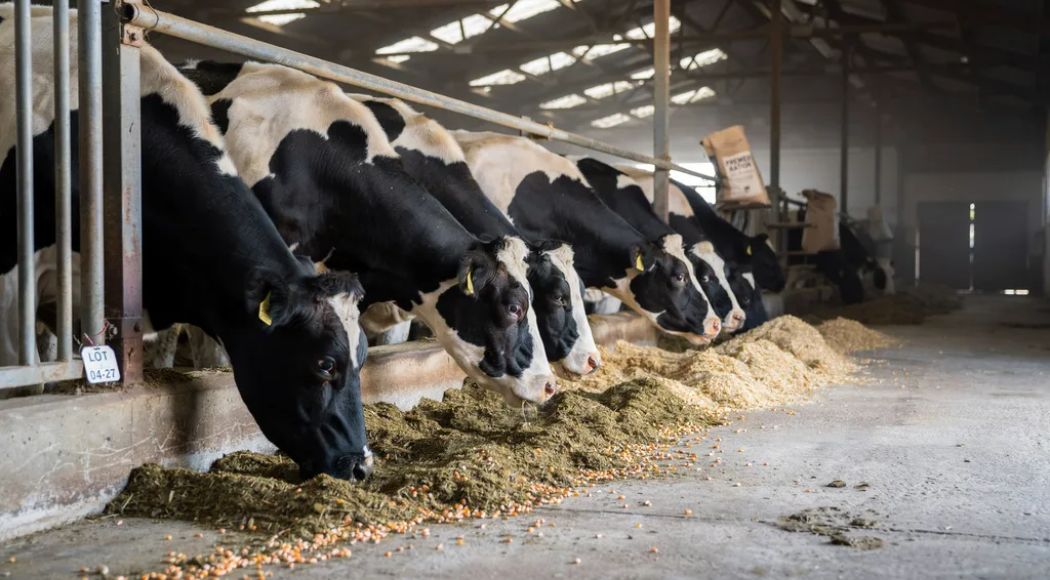
The most effective modern approach to dairy cattle feed delivery is the Total Mixed Ration (TMR) system. TMR combines all feed ingredients—silage, concentrates, minerals, and supplements—into a single, uniform blend delivered to the feed bunk. This prevents selective eating, ensures every cow receives a nutritionally balanced mouthful, and improves dry matter intake consistency across the herd.
Step-by-step TMR feeding method:
- Formulate the ration using a nutritionist based on current forage analysis results
- Weigh all ingredients accurately using a calibrated mixer wagon
- Blend in the correct order long fibre first, concentrates second, liquids last
- Deliver feed at least twice daily; push up feed every 2–3 hours to maintain accessibility
- Monitor refusals daily; target a 3–5% refusal rate to confirm ad lib access without waste
- Adjust the ration at key transition points: dry period, close-up, fresh cow, peak lactation
The MSD Veterinary Manual confirms that all feeding groups, including replacement heifers, dry cows, and lactating cows, benefit from TMR systems. For optimal performance, lactating cows should be separated into at least two groups based on production level, with the ration balanced above the group mean to meet higher-producing cows’ requirements.
How Does Feed for Dairy Cattle Differ From Beef Cattle?
This is one of the most practically important distinctions in livestock nutrition, and the differences are fundamental:
| Factor | Dairy Cattle Feed | Beef Cattle Feed |
| Primary goal | Maximise milk yield and composition | Maximise weight gain (muscle deposition) |
| Protein requirement | 16–18.5% CP (lactating cows) | 10–12% CP (finishing cattle) |
| Energy density | High supports lactation and maintenance | Moderate supports growth |
| Forage:concentrate ratio | 50:50 to 60:40 | 70:30 to 80:20 (grass-fed) or reversed (feedlot) |
| Feed cost per animal | Higher production demands are greater | Lower, simpler ration required |
| Feeding frequency | Twice daily minimum; TMR preferred | Once daily or ad lib grazing acceptable |
| Mineral focus | Calcium, phosphorus, magnesium critical post-calving | Copper, selenium key for growth |
| Dry matter intake | 3–4% of body weight daily | 2–2.5% of body weight daily |
A dairy cow producing 30 litres per day has dramatically higher nutritional demands than a beef animal of the same weight. Failing to recognise this distinction and underfeeding dairy cattle as if they were beef animals is a common cause of negative energy balance, poor fertility, and rapid condition loss.
How Many Tons of Feed Does a Dairy Cow Need Per Year?
A high-yielding dairy cow producing 8,000–10,000 liters per year typically consumes:
- Forage: 5–7 tonnes dry matter per year (approximately 20–25 tonnes as fed grass silage)
- Concentrate: 1.5–3 tonnes per year depending on forage quality and yield level
- Total feed intake: Approximately 6–10 tons of dry matter annually
For a 100-cow herd, this equates to 600–1,000 tonnes of dry matter per year, a planning figure critical for forage budgeting, storage capacity, and winter feed purchasing.
The NASEM 2021 guidelines confirm dry matter intake typically peaks at 8–12 weeks into lactation, later than peak milk production at 6–10 weeks, creating a natural negative energy balance window that must be managed through ration formulation and body condition monitoring.
What Is Challenge Feeding in Dairy Cattle?
Challenge feeding, also called lead feeding or steaming up, is the practice of gradually increasing concentrate levels in the ration of dry cows during the 3–6 weeks before the expected calving date. Rather than abruptly introducing high concentrate levels after calving when demand peaks, challenge feeding allows the rumen microflora and rumen wall papillae to adapt progressively to higher starch and energy density diets.
Cornell University’s close-up dry cow guidelines recommend feeding be available 24 hours per day during the 3 weeks prepartum, with rations providing 27–28 lb of dry matter daily.
What Is an Advantage of Challenge Feeding in Dairy Cattle?
The primary advantages of challenge feeding are well-supported by clinical evidence:
- Reduced metabolic disease risk Gradual rumen adaptation lowers the incidence of acidosis, displaced abomasum, and ketosis in the fresh cow period
- Higher peak milk yield: Cows entering lactation with adapted rumens achieve higher dry matter intake more rapidly post-calving
- Improved body condition management Prevents excessive condition loss in early lactation by supporting higher intake from day one
- Better reproductive performance Cows in better energy balance at peak lactation return to oestrus more reliably
- Reduced transition cow health costs Fewer veterinary interventions in the critical first 30 days post-calving
Challenge feeding is now considered standard best practice in high-performance dairy systems across the UK, Ireland, and North America.
Why Is High Protein Feed Given to Dairy Cattle?
Protein is the most expensive and most critical macronutrient in dairy cattle feed and understanding why high protein levels are required for lactating cows is essential for both ration formulation and farm economics.
Milk protein synthesis demands a continuous supply of metabolizable protein (MP), the true protein digested in the small intestine. A cow producing 30 liters per day requires approximately 16–18.5% crude protein (CP) in the diet dry matter. A dry cow requires only 11–12% CP.
According to NCBI/NIH published NASEM research, metabolizable protein supply is the primary protein metric in modern dairy nutrition, not crude protein alone. MP comes from two sources:
- Rumen Microbial Protein (MCP) produced by rumen bacteria fermenting rumen-degradable protein (RDP) and energy
- Rumen Undegradable Protein (RUP/bypass protein) passes through the rumen undigested and is absorbed in the small intestine
Why high protein matters at a glance:
| Protein Function | Impact on Cow Performance |
| Milk protein synthesis | Directly determines milk protein % and yield |
| Muscle maintenance | Prevents condition loss in early lactation |
| Enzyme and hormone production | Supports reproduction and immune function |
| Rumen microbial growth | Fuels fermentation efficiency and energy extraction |
| Colostrum quality | Critical for newborn calf immunity |
When protein is inadequate in dairy cattle feed, the cow mobilizes body muscle tissue to meet milk protein demands, resulting in rapid condition loss, poor fertility, compromised immunity, and reduced longevity in the herd.
High-quality protein sources used in UK dairy rations include rapeseed meal, soya bean meal, distillers grains, and protected (bypass) protein supplements such as heat-treated soya.
Conclusion
Dairy cattle feed is not simply about filling the feed bunk. It is a precision science that directly determines the profitability, health, and longevity of every cow in your herd.
Key takeaways:
- The main feeds are grass silage, maize silage, and compound concentrates balanced as a TMR
- A high-yielding cow needs 6–10 tonnes of dry matter annually; plan forage budgets accordingly
- Dairy cattle require significantly higher protein (16–18.5% CP) and energy density than beef cattle
- Challenge feeding pre-calving reduces transition disease, improves peak yield, and supports fertility
- High-protein feeds support milk protein synthesis, muscle maintenance, rumen function, and immune health
- TMR delivery twice daily with 3–5% refusal targets is the gold standard feeding system
Work with a qualified ruminant nutritionist to formulate rations based on current forage analysis. Every batch of silage is different, and a ration built on assumptions rather than data is a ration built to underperform.