How a Clothes Dryer Works 2026: Guide & Money Tips
Every morning, millions of people pull warm, dry clothes from a machine they have never truly thought about. A clothes dryer sits in a laundry room, does its job in silence, and asks for almost nothing in return until something goes wrong. That is when people suddenly need to understand how a clothes dryer works, and the answers are more fascinating than most expect. Searching “how a clothes dryer works” is one of the most common home appliance queries in 2026.
- A Brief History: How People Dried Clothes Before the Modern Dryer
- How a Clothes Dryer Works: The Core Principles
- Key Parts of a Clothes Dryer and Their Functions
- Electric vs. Gas Dryers: A Mechanical Comparison
- How to Care for Your Dryer During Use
- Common Reasons a Clothes Dryer Stops Working
- The Future of Clothes Dryers: What 2026 Looks Like
- Conclusion: Why Understanding Your Dryer Matters
Understanding how a clothes dryer works is not just useful knowledge for troubleshooting it helps you use the appliance more efficiently, extend its lifespan, reduce energy bills, and prevent safety hazards including fire. This guide covers the full picture: the history of clothes drying from ancient sun-drying to modern smart appliances, the complete mechanical and electrical working principles, all major components and their dimensions, proper care practices, and the most common reasons a dryer stops working.
A Brief History: How People Dried Clothes Before the Modern Dryer
To fully appreciate how a clothes dryer works today, it helps to understand the long journey it took to get here.
Ancient and Traditional Methods
For thousands of years, humanity relied entirely on nature to dry wet clothing. The most common method was sun-drying spreading garments flat on rocks, grass, or bushes and allowing solar heat and wind to evaporate moisture. In cloudier climates, people hung clothes in well-ventilated indoor spaces near open fires or hearths. These methods worked, but they were weather-dependent, time-consuming, and in colder or wetter seasons, almost impractical.
The First Mechanical Dryers (1800s)
The first step toward mechanization came in France around 1799–1800, when an inventor named Pochon created what he called the “ventilator” a perforated metal drum that users rotated by hand over an open fire. It was the first time rotation and heat were combined to dry clothing. The concept was sound, but the execution was dangerous: clothes frequently came out smelling of smoke, covered in soot, and occasionally singed.
In 1892, African American inventor George T. Sampson of Ohio received a U.S. patent for an improved ventilated dryer that used heat from a stove rather than an open flame. While still limited, Sampson’s design is considered a foundational step toward modern tumble dryers.
The Electric Era (1930s–1950s)
The true turning point came through the persistence of J. Ross Moore, a North Dakota farmer who spent 30 years developing an automatic drum-type dryer to avoid hanging clothes in harsh winter conditions. By 1938, Hamilton Manufacturing Company of Wisconsin was selling Moore’s design commercially under the name “June Day” the first electric clothes dryer available to household consumers.
Through the 1940s and 1950s, as electricity became widespread in American and European homes, dryers grew rapidly in popularity. Front-panel controls, timers, temperature regulation, and cool-down cycles were added by 1946. By the 1970s, gas-powered dryers became an energy-efficient alternative. Today, heat pump dryers, sensor-controlled cycles, and Wi-Fi-connected smart dryers represent the latest evolution and the machines keep getting more efficient and safer every decade.
How a Clothes Dryer Works: The Core Principles
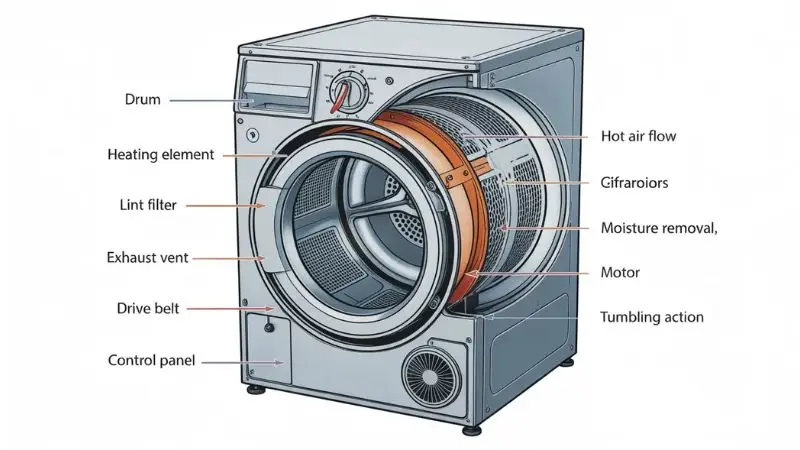
At its simplest, understanding how a clothes dryer works means understanding three simultaneous processes: heat generation, airflow circulation, and mechanical tumbling. All three must work together. If any one fails, clothes will not dry.
Heat Generation
Every dryer must produce heat to evaporate moisture from wet fabric. How that heat is generated depends on the type of dryer:
- Electric dryers use a resistance heating element a coiled wire that heats up when electrical current passes through it, similar in principle to a toaster. Most electric dryers require a 240-volt connection and operate at temperatures between 120°F and 160°F (49°C–71°C).
- Gas dryers use a gas burner (natural gas or propane) ignited by an electronic igniter or pilot light. Metal plates absorb and distribute the heat into the drum. Gas dryers still require electricity to power the motor, controls, and igniter.
- Heat pump dryers (increasingly common in 2026) use a refrigerant cycle to extract and recycle heat from the surrounding air rather than generating new heat. They are significantly more energy-efficient but have longer drying cycles.
Airflow Circulation
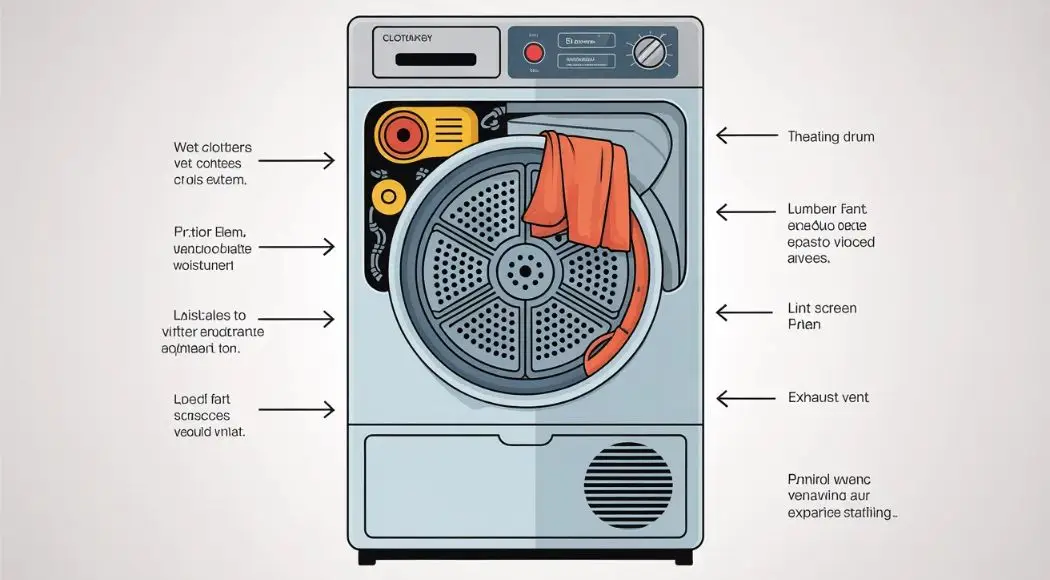
Heat alone is insufficient. The moisture evaporated from clothes must be continuously carried out of the drum. A blower fan (also called a blower wheel) draws cool air in through an intake vent, passes it over the heating element, and pushes the now-heated air into the drum. As this hot air circulates through the tumbling clothes, it absorbs moisture and becomes humid. This saturated air is then expelled through the lint filter, into the exhaust duct, and out of the home via an external vent.
In ventless condenser dryers, rather than expelling moisture outside, the humid air is passed over a cool surface where the moisture condenses into water, which is collected in a reservoir or drained away.
Mechanical Tumbling
The dryer works by tumbling clothing in a large drum equipped with baffle fins raised ridges inside the drum that cause gaps to form between fabrics, allowing more hot air to pass between individual articles of clothing. Without tumbling, clothes would clump together and the hot air could not reach all surfaces evenly.
Key Parts of a Clothes Dryer and Their Functions
Understanding how a clothes dryer works requires knowing the role of each major component:
| Part | Function | Notes |
| Drum | Rotating cylinder that holds clothes | Typically 5–9 cu ft capacity; stainless steel or porcelain-coated |
| Heating Element / Gas Burner | Generates heat to evaporate moisture | Electric: 240V coil; Gas: burner with igniter |
| Drive Motor | Powers both drum rotation and blower fan | Converts electrical energy into mechanical motion |
| Drive Belt | Connects motor to drum for rotation | Thin rubber belt; loops around drum circumference |
| Idler Pulley | Maintains tension on the drive belt | Spring-loaded; keeps belt from slipping |
| Blower Fan | Circulates air through drum and out exhaust | Attached to motor shaft |
| Thermostat (Cycling) | Regulates operating temperature | Cycles heat on and off to maintain set temperature |
| Hi-Limit Thermostat | Safety cut-off if drum overheats | Prevents fire; must be replaced if triggered |
| Thermal Fuse | One-time safety device; cuts power if overheating | Requires replacement after activation |
| Lint Filter | Traps fibre particles from exhaust air | Must be cleaned after every cycle |
| Door Switch | Signals the dryer to operate only when door is closed | Safety component; dryer won’t run if switch fails |
| Moisture Sensor | Detects remaining moisture in clothes | Ends cycle automatically when clothes are dry |
| Control Panel / Timer | Sets cycle type, temperature, and duration | Electromechanical or digital depending on model |
| Exhaust Duct | Carries moist air out of the home | Must be kept clear; primary fire risk when blocked |
Standard Dryer Dimensions (2026): Most full-size residential dryers measure approximately 27–29 inches wide, 27–28 inches deep, and 36–43 inches tall. Drum capacity typically ranges from 5.8 to 9.0 cubic feet. Compact models for apartments and smaller spaces average 24 inches wide with 3.4–4.0 cubic feet of drum capacity.
Electric vs. Gas Dryers: A Mechanical Comparison
| Feature | Electric Dryer | Gas Dryer |
| Heat source | 240V resistance heating element | Gas burner (natural gas or propane) |
| Electricity required | Yes (240V circuit) | Yes (120V for motor and controls) |
| Installation cost | Lower | Higher (gas line required) |
| Operating cost | Higher per cycle | Lower per cycle (gas cheaper than electricity) |
| Drying speed | Slightly slower | Slightly faster |
| Safety considerations | Risk of element failure | Risk of gas leak; requires proper ventilation |
| Heat pump option | Yes | No |
For the U.S. Department of Energy’s guidance on dryer energy consumption and efficiency ratings, visit the Energy Star Appliance Resource a trusted government-backed reference for efficiency standards.
How to Care for Your Dryer During Use
Proper maintenance directly extends the lifespan of a clothes dryer and reduces fire risk. The U.S. Consumer Product Safety Commission estimates that clothes dryers cause approximately 15,000 home fires annually in the United States, with clogged exhaust ducts as the leading cause.
Daily Care:
- Clean the lint filter before or after every single cycle a clogged filter restricts airflow and forces the dryer to work harder
- Never run the dryer while away from home or asleep
- Avoid overloading the drum clothes need space to tumble freely
Monthly Care:
- Wipe the inside of the drum with a damp cloth to remove residue from dryer sheets or fabric softeners
- Check the external vent flap to ensure it opens and closes freely
Annual Care:
- Disconnect and clean the entire exhaust duct from dryer to exterior vent using a dryer duct cleaning brush kit
- Inspect the drive belt for cracks or fraying
- Verify the moisture sensor bars (inside the drum, near the lint filter) are clean wipe with rubbing alcohol to remove fabric softener coating that reduces accuracy
What NOT to do:
- Never dry clothing contaminated with flammable substances (petrol, cooking oil, solvents) residues can ignite
- Never use a kinked or plastic accordion-style exhaust duct use rigid or semi-rigid metal ducting only
- Do not run soaking-wet clothes directly in the dryer; always complete a full spin cycle in the washing machine first
Common Reasons a Clothes Dryer Stops Working
A clothes dryer works through three main components: heat, airflow, and motion. If any one function does not work, the clothes will not dry. Here are the most common failure points and their causes:
1. Dryer Runs But Produces No Heat
- Blown thermal fuse (most common cause usually triggered by a blocked exhaust duct)
- Failed heating element (electric) or faulty gas igniter
- Tripped hi-limit thermostat
2. Dryer Does Not Start At All
- Door switch failure the dryer will not operate unless the door switch registers as closed
- Broken start switch or failed control board
- Blown household fuse or tripped circuit breaker (electric dryers require a dedicated 240V circuit)
3. Dryer Takes Too Long to Dry Clothes
- Clogged lint filter or blocked exhaust duct (most common cause)
- Worn drive belt causing the drum to rotate too slowly
- Failing cycling thermostat causing intermittent heat
- Dirty moisture sensor providing inaccurate readings
4. Dryer Makes Loud Noise During Operation
- Worn drum support rollers (squealing or thumping)
- Failing idler pulley (screeching)
- Broken or frayed drive belt (slapping sound)
- Item caught between drum and cabinet
5. Dryer Overheats or Shuts Off Mid-Cycle
- Blocked exhaust duct forcing heat to build up inside the drum
- Failing cycling thermostat not cycling heat off properly
- Hi-limit thermostat activating as a safety response to overheating
Real-World Example: A 2024 analysis by Sears Home Services confirmed that the single most common dryer repair call is a blown thermal fuse caused by a clogged exhaust duct a failure that costs between $75–$150 to repair but costs nothing to prevent with annual duct cleaning.
The Future of Clothes Dryers: What 2026 Looks Like
The clothes dryer is evolving rapidly. Heat pump dryers which use refrigerant cycles to dry clothes using 28–50% less energy than conventional electric dryers are now the dominant technology in European markets and growing significantly in North America. Wi-Fi connected smart dryers can now send smartphone notifications, auto-detect load size, and sync with smart grid electricity pricing to run cycles during low-cost hours. Steam-refresh cycles allow lightly worn clothes to be de-wrinkled and freshened without a full wash.
The future of how a clothes dryer works will be defined by efficiency, and manufacturers investing in heat pump and smart technology are redefining how a clothes dryer works at the household level, reduced environmental impact, and greater automation but the core physics of heat, airflow, and tumbling will remain unchanged.
Conclusion: Why Understanding Your Dryer Matters
Fully knowing how a clothes dryer works is practical knowledge with real consequences. It informs smarter usage habits, reduces energy consumption, prevents the fire risks associated with clogged vents, and helps you diagnose and explain problems before paying for repairs. The dryer’s job is deceptively simple evaporate moisture from fabric using heat, airflow, and motion but the engineering that delivers that result is precise and interconnected.
Clean your lint filter every cycle. Clear your exhaust duct annually. Do not overload the drum. Respect the thermal fuse as the safety device it is. These four habits alone will extend the lifespan of your dryer by years and significantly reduce fire risk in your home.